

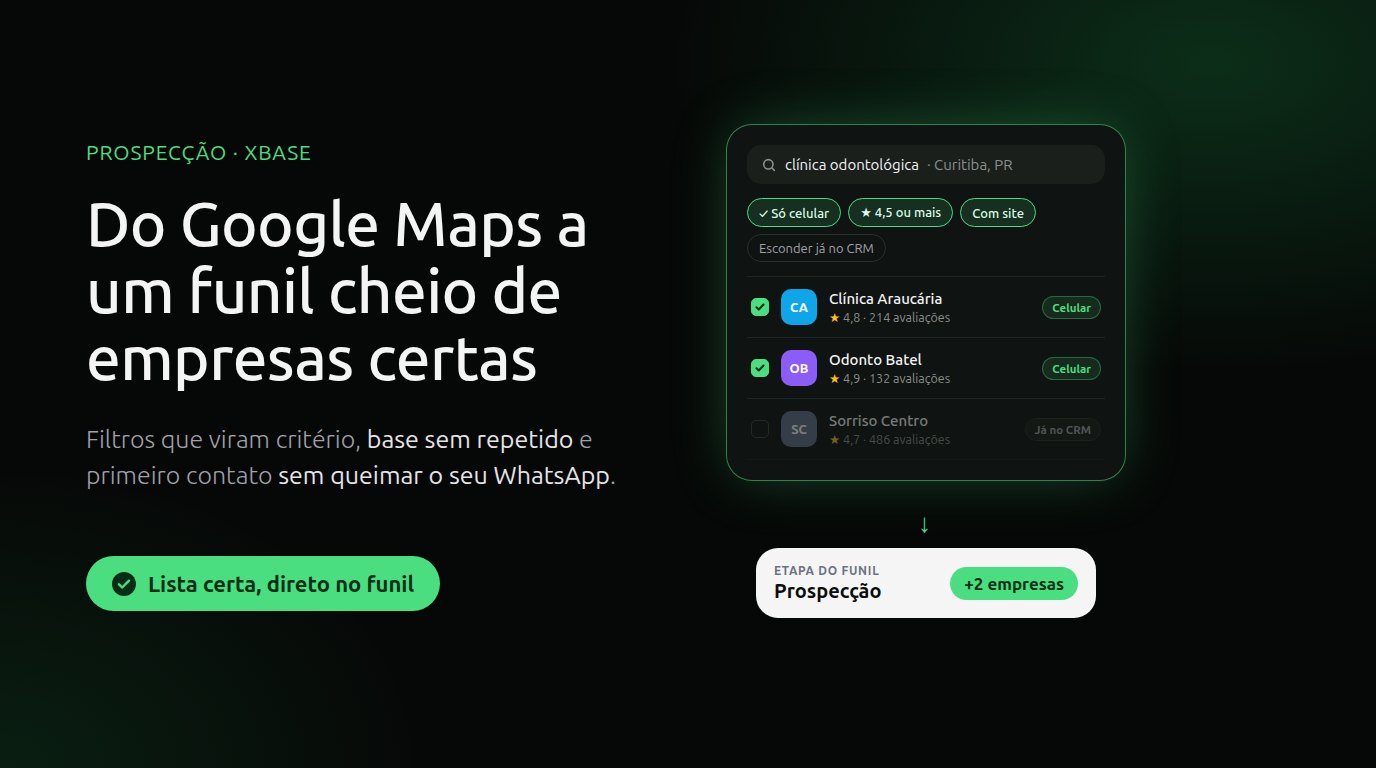
The power of Prospecting: Google Maps, Instagram and B2B companies in a pipeline full of the right businesses
If you sell to businesses, you are never short of businesses to call. The local business has a Google Maps profile, the small brand lives on Instagram and the mid-size company has a LinkedIn page. The hard part is something else: turning those storefronts into a list your team can actually work, without losing an afternoon copying listings, without calling the same business twice and without burning your company's WhatsApp number.
XBASE Prospecting was built for that job. It searches three sources, Google Maps, Instagram and a B2B company database, and sends the ones you pick straight to a pipeline stage. This guide shows what it changes in practice and how to use it strategically, from choosing the source to the first conversation.
New to Prospecting? The step by step to connect and run your first search is in the post Find customers on Google Maps and send them straight to your funnel.
Where manual prospecting gets stuck
- Time: opening listing after listing and copying name, phone and website into a spreadsheet eats the afternoon that should go to calls.
- Wrong number: many published phones are landlines, and the team only finds out when trying to reach them on WhatsApp.
- Duplicates: the spreadsheet doesn't talk to the CRM. The same business gets added twice or gets called by two people.
- No criteria: without filters, the team spends energy on businesses that would never buy.
- No follow-up: after the call, nobody knows where each business stands.
1. Pick the right source
Every kind of customer lives somewhere. Prospecting lets you choose the source before searching, and the list, the filters and sending to the pipeline work the same in all three.
| You are looking for | Source | What comes back |
|---|---|---|
| Local business (clinic, restaurant, repair shop) | Google Maps | mobile and landline split, website, Instagram, rating, reviews, address and category |
| Brand that sells on Instagram (bakery, store, studio) | handle, name, bio, followers and verified badge; mobile and email when they are in the bio | |
| Mid-size or B2B company (software, industry, services) | B2B companies | name, website, LinkedIn page, industry, headcount and address |
On Google Maps, you search by topic and city, and the broad search visits each business's website to find emails and socials. On Instagram, you search by a keyword in the bio, and XBASE reads the number and email the person put there; private profiles are left out. In the B2B database, you search by keyword and location, among companies with a LinkedIn page.
2. Criteria before volume
The second power of Prospecting is turning your ideal customer profile into filters. Some go out with the search: topic, city or region, Google category, quantity, minimum rating and with or without a website. Others XBASE applies to the list that came back: mobile only, minimum reviews, has Instagram, has email and hide those already in your CRM.
A few examples of how to turn your ideal customer into a source, a search and a filter:
| You sell | Source and search | Filter by |
|---|---|---|
| Websites and digital marketing | Google Maps: the niche + the city | no website, few reviews |
| Software for clinics | B2B companies: "dental clinic" + the state | with website |
| Distribution to restaurants | Google Maps: "restaurant" + the neighborhood | mobile only, minimum reviews |
| Services for businesses that sell on Instagram | Instagram: "bakery" + the city | mobile in the bio, without those in your CRM |
After the search, the list still goes past your eyes: quick filters with counts, sorting, search inside the list and a button to discard what doesn't fit.
3. A database without duplicates
Every business on the list is checked against your CRM by Google place, Instagram handle, LinkedIn page and phone, with and without Brazil's extra ninth digit. Existing contacts show the Already in CRM badge, and you can hide those businesses from the list. If you send one anyway, XBASE uses the existing contact and just moves its conversation to the stage. Your database grows without duplicates.
4. From the list to a pipeline stage
Once you have picked the businesses, Send to pipeline asks for the pipeline and the stage. Each business becomes a contact with what the source brought: name, phone (the mobile number for WhatsApp and the landline for calls), email, website, address and industry. And it gets a conversation in that stage. At the end, XBASE shows how many contacts were created, how many already existed and how many changed stage.
This is where prospecting stops being a spreadsheet and becomes a process. Each business has a card, the team moves the card as the conversation progresses, and stage conversion shows how many conversations go from one stage to the next. With one stage or one pipeline per source or niche, you can compare what responds best using the numbers from your own pipeline.
If part of the work happens outside XBASE, export the list to Excel or CSV.
5. First contact without burning your number
This is what separates prospecting that lasts from prospecting that burns the channel. The WhatsApp Business policy is clear: a business may only message someone on WhatsApp if that person gave it their number and agreed to receive messages. A phone number published on Google Maps or in an Instagram bio is not that permission.
And WhatsApp keeps score. Your number's quality is calculated from what people do with your messages over the last seven days, such as blocking, reporting, muting and archiving. With too much negative feedback, WhatsApp may limit your message volume and even restrict the business's access. The same care applies on Instagram: messages nobody asked for can be reported there too.
What works:
- First contact by phone or email. Prospecting brings the landline, the mobile number and, when it finds one, the email. Open the conversation with what the search showed: the neighborhood, the rating, the followers, whether the business has a website.
- Ask to continue on WhatsApp. Once the business agrees, the conversation moves to official WhatsApp, in the XBASE inbox, where AI suggests the replies and your team sends them. If the first message on that channel comes from your company, it has to be a Meta-approved message template. If you prefer, send your WhatsApp link in the email so the business messages you first.
- Respect anyone who asks you to stop. The policy requires honoring requests from people who no longer want to receive messages, on and off WhatsApp.
- Work short lists. Start with 20 businesses, make the contacts, see how many move forward and adjust the source and the filters before the next search.
Prospecting doesn't message anyone, neither on WhatsApp nor on Instagram Direct. It delivers the right list to the right place; outreach stays with your team.
6. Pricing
Each search is paid from the prepaid balance of the data account you connect to XBASE the first time. XBASE charges nothing extra for Prospecting.
| Search | When | Approximate cost |
|---|---|---|
| Google Maps, quick | one topic and up to 20 businesses | cents per search |
| Google Maps, broad | more than one topic or more than 20 businesses | about US$0.009 per business, plus US$0.01 per search |
| up to 100 profiles | about US$0.002 per page of around 45 profiles | |
| B2B companies | up to 200 companies | about US$0.0004 per company |
In practice, a list of 100 businesses in a broad Google Maps search costs about US$0.91, and the same number in the B2B database costs a few cents. The broad Maps search costs more because it visits each business's website to find emails and social profiles. The cost of each search shows on screen, and the balance sits at the top of Prospecting. Prices checked on 10/28/2026.
A plan for your first week
- Connect the data account in Contacts → Prospecting and create the stage in your pipeline that will receive the businesses.
- Pick one source, one niche and one city and run a small search of up to 20 businesses.
- Filter and review: mobile only or with website, minimum rating, without those already in your CRM.
- Send them to the stage and split the contacts among your team members.
- At the end of the week, see how many businesses moved forward and adjust the source, the niche and the filters.
Get started
- See the Prospecting page, with what it does and what it doesn't.
- Follow the tutorial How to find customers on Google Maps and send them to the funnel.
- Read the full rules in the documentation Lead prospecting.
Sources
- WhatsApp Business — WhatsApp Business Messaging Policy (opt-in, requests to stop and user feedback): business.whatsapp.com/policy
- Meta for Developers — message quality (blocks, reports, mutes and archives over the last seven days): developers.facebook.com
Keep reading
From script to Reels ad without leaving XBASE
Create the Reels in the Studio in 6 steps, already in the format Meta recommends for ads (9:16, with sound and text in the safe zone), and take the piece to the ad set with the WhatsApp button.
Read articleFind customers on Google Maps and send them straight to your funnel
Enter a topic and a city: XBASE Prospecting brings in businesses from Google Maps with phone, website and rating, keeps the ones with a mobile number and sends the leads you pick to a funnel stage.
Read article